At the closing session of the fourth APEC Business Advisory Council (ABAC) Meeting of 2026 in Shenzhen, China, Mr. Dang Thanh Tam, representative of ABAC Vietnam, received the ceremonial token known as the “Ruyi Chengli”, officially marking the transition of the regional business community’s leadership role to Vietnam ahead of APEC 2027.
At the closing session of the fourth APEC Business Advisory Council (ABAC) Meeting of 2026 in Shenzhen, China, Mr. Dang Thanh Tam, representative of ABAC Vietnam, received the ceremonial token known as the “Ruyi Chengli”, officially marking the transition of the regional business community’s leadership role to Vietnam ahead of APEC 2027.
The fourth ABAC Meeting of 2026 took place from 14 to 16 November 2026 in Shenzhen, China, hosted by the China Council for the Promotion of International Trade (CCPIT). The event marked the conclusion of the Asia-Pacific business community’s annual agenda for 2026.
A key highlight of the closing session was the official handover ceremony between the 2026 and 2027 host economies. In a formal setting, Mr. Li Fanrong, Chair of ABAC 2026, presented the ceremonial token, the “Ruyi Chengli”, to Mr. Dang Thanh Tam, representative of ABAC Vietnam.
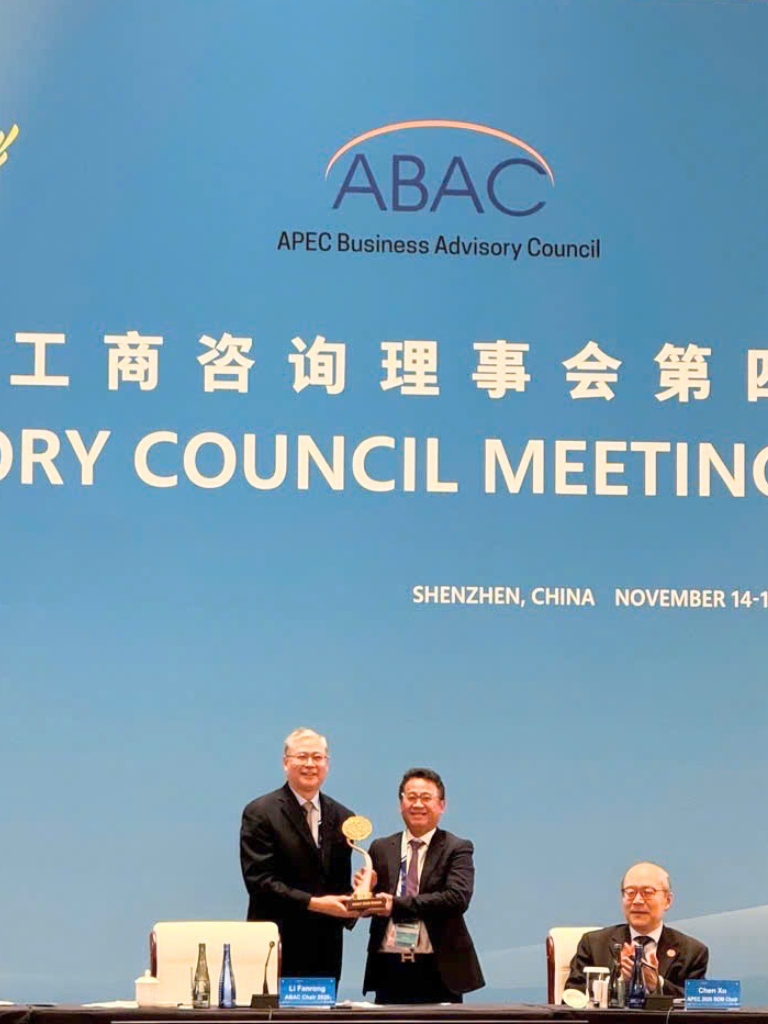
ABAC 2026 Chair presents the “Ruyi Chengli” to Mr. Dang Thanh Tam, representative of ABAC Vietnam.
The ceremonial handover carried not only symbolic significance, representing continuity and sustained cooperation among member economies, but also formally marked the transfer of hosting responsibilities and leadership of ABAC activities to Vietnam as it prepares for APEC 2027.
Vietnam’s assumption of the ABAC leadership role for 2027 further underscores the proactive and constructive engagement of the Vietnamese business community in advancing initiatives that promote trade and investment liberalization, economic integration, and regional connectivity across the Asia-Pacific.
The APEC Business Advisory Council (ABAC) serves as the official advisory mechanism representing the voice of the private sector to the leaders of the 21 APEC member economies. It plays a central role in fostering policy dialogue, trade, investment, and regional economic cooperation.
Appointed by the Prime Minister of Vietnam as an ABAC member in March 2007, Mr. Dang Thanh Tam has contributed nearly two decades to regional economic dialogue and cooperation. His receipt of the ceremonial handover token ahead of APEC 2027 further affirms his role and standing in international economic cooperation while strengthening the voice of Vietnam’s business community within APEC.
ADDITIONAL INFORMATION ABOUT ABAC
The APEC Business Advisory Council (ABAC) is the official business advisory body to the leaders of the Asia-Pacific Economic Cooperation (APEC) forum, which comprises 21 member economies. The leader of each APEC economy appoints three distinguished business representatives to ABAC. ABAC’s role is to convey the views, recommendations, and policy advice of the business community directly to 21 APEC Leaders. It serves as the official bridge connecting the private sector with APEC leaders and policymaking bodies.
Six Main Functions and Responsibilities:
1. Advising APEC Leaders on Policy
Recommending policies to promote economic growth.
Proposing measures to improve the business and investment environment.
Recommending solutions to remove trade barriers.
Bringing the voice of the business community into the regional policymaking process.
2. Promoting Trade and Investment
Advancing trade and investment liberalization.
Strengthening market connectivity among the 21 economies.
Supporting regional supply chains.
Facilitating cross-border investment expansion.
3. Driving Digital Transformation and Innovation
Promoting the digital economy and e-commerce.
Encouraging the adoption of AI and emerging technologies.
Developing digital infrastructure and cybersecurity.
Fostering innovation within businesses.
4. Promoting Sustainable Development
Supporting the transition to green energy.
Enhancing energy security.
Advancing low-carbon economic development.
Strengthening food security and high-tech agriculture.
5. Strengthening Business Community Connectivity
Connecting large corporations with small and medium-sized enterprises (SMEs).
Promoting investment cooperation among member economies.
Creating opportunities for dialogue between businesses and governments.
Developing regional economic cooperation initiatives.
6. Contributing to APEC Programs and Initiatives
Providing input to APEC working groups.
Offering business perspectives to APEC forums upon request.
Recommending practical initiatives and solutions.
Role of ABAC:
For APEC Leaders: Direct policy advice and recommendations
For Governments: Policy dialogue and recommendations
For APEC Ministers: Sector-specific policy input
For Businesses: Representation of the private sector’s voice
For Investment Promotion: Recommendations to improve the investment climate and facilitate trade
For International Cooperation: Connecting businesses across all 21 APEC economies